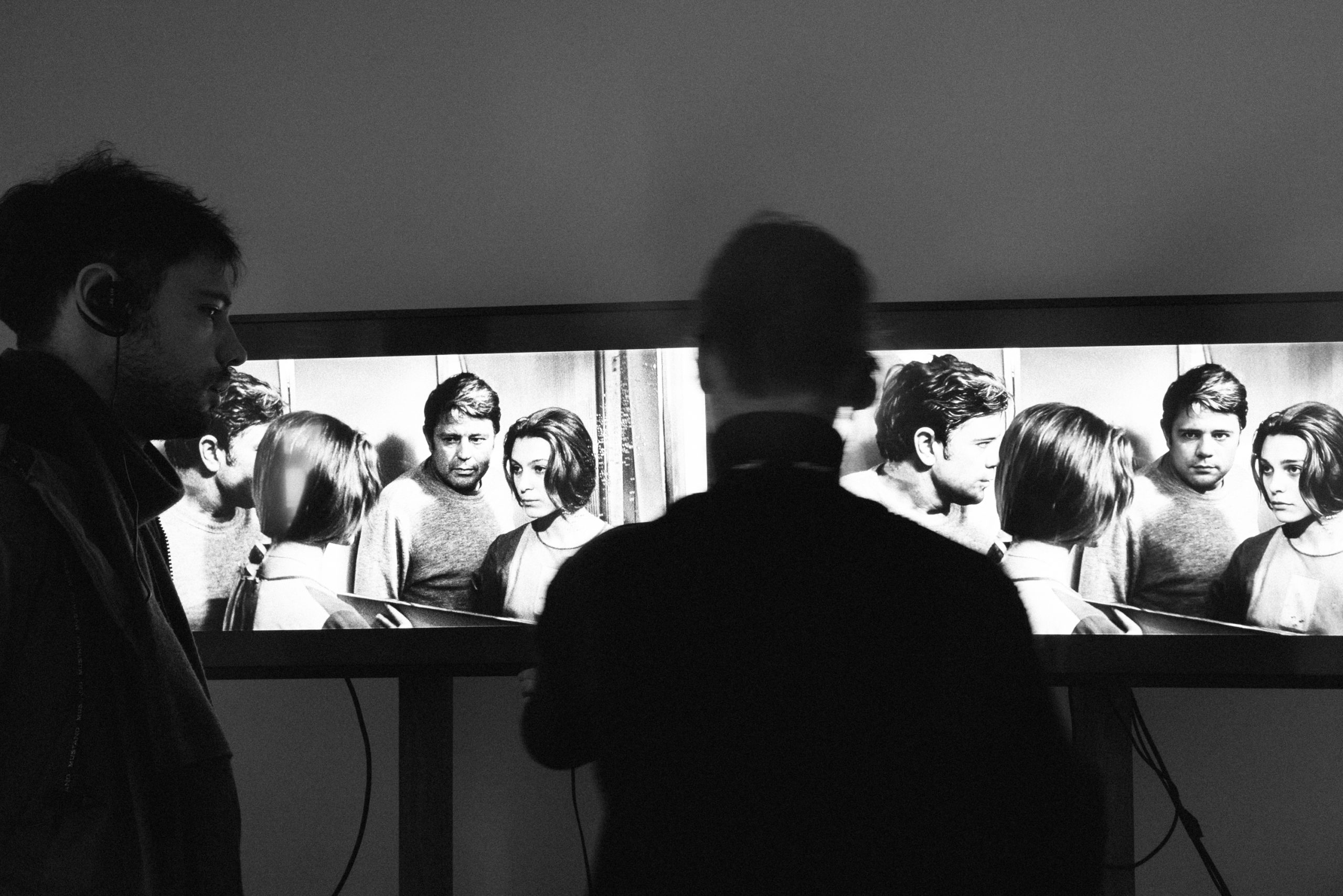
Drawing on Stanisław Lem’s novel and Andrei Tarkovsky’s cult film, SOLARIS TWO shifts fundamental questions of conscience, love, and the limits of knowledge into our present—an era in which identities are increasingly built through data, and memories return as images that can be produced, altered, or falsified. At the heart of the concept is a simple question: what happens when theatre meets its cinematic source face to face—and, in doing so, gains yet another, computer-generated version of itself?
The production turns the stage into a laboratory of perception where film appears as an archive, live performance as the present, and a third layer emerges from their real-time merging. Instead of the biological Ocean that materializes the repressed in the original, the piece introduces a “digital ocean”—an endless cloud of data from which generative artificial intelligence produces doubles and returns them to the space of viewing. Technology here is not decoration but a dramaturgical engine: the performer’s living body constantly collides with a digital mask, and the boundary between the “real” and the “produced” becomes part of the action.
At the center of the story is the psychologist Kris Kelvin (Matija Čigir), while the characters in this staging unfold as multi-layered constructs. Even the film Solaris, on the level of performance, had its own “seams” between image and voice, between presence and borrowing—and SOLARIS TWO brings that split to the surface and turns it into a stage mechanism. A similar principle shapes the character of Dr. Snaut (Nikola Nedić), who stands on the threshold between a living body and an archive, between what has been “recorded” and what is happening now, in front of the audience.
The most emotional layer of the production is concentrated in the character of Hari (Rea Bušić). In Solaris, Hari has always been a figure of love returning as something tangible and yet radically unreal—a human double drawn from memory. In SOLARIS TWO, this paradox is further fractured through three presences of the same person: cinematic, theatrical, and computer-generated. In this triple encounter, the question of love also becomes a question of trust in the image: who has a claim to the “original” when copies can be multiplied without end, and what does it even mean to believe your own eyes at a time when evidence is persuasive but unstable?
SOLARIS TWO continues MONTAЖ$TROJ’s exploration of the relationship between image, reality, and artificial intelligence, begun with the project THE BLIND LEADING THE BLIND, where Bruegel’s Parable of the Blind served as a metaphor for blind faith, (mis)information, and the manipulation of truth in a digitalized world. The new work shifts its focus toward doubles and identity—toward the question of whom we trust when reality can be produced, not only recorded.
Cast: Matija Čigir (Kris Kelvin), Rea Bušić (Hari), Nikola Nedić (Snaut), Sven Medvešek (Sartorius), and on video Frano Mašković (Gibarian).
The premiere of SOLARIS TWO will be held at the Istrian National Theatre – City Theatre Pula on 30 January 2026 at 8 p.m., with a reprise on 31 January 2026 at 8 p.m. After the Pula premiere, the production will also be performed at the Zagreb Youth Theatre on 24 and 25 February 2026, when Zagreb audiences will encounter this new exploration of love, memory, and artificial intelligence on stage for the first time.