WATERMELON

From a pub quiz on Palestine to a reconstruction of the crime at Nirim.

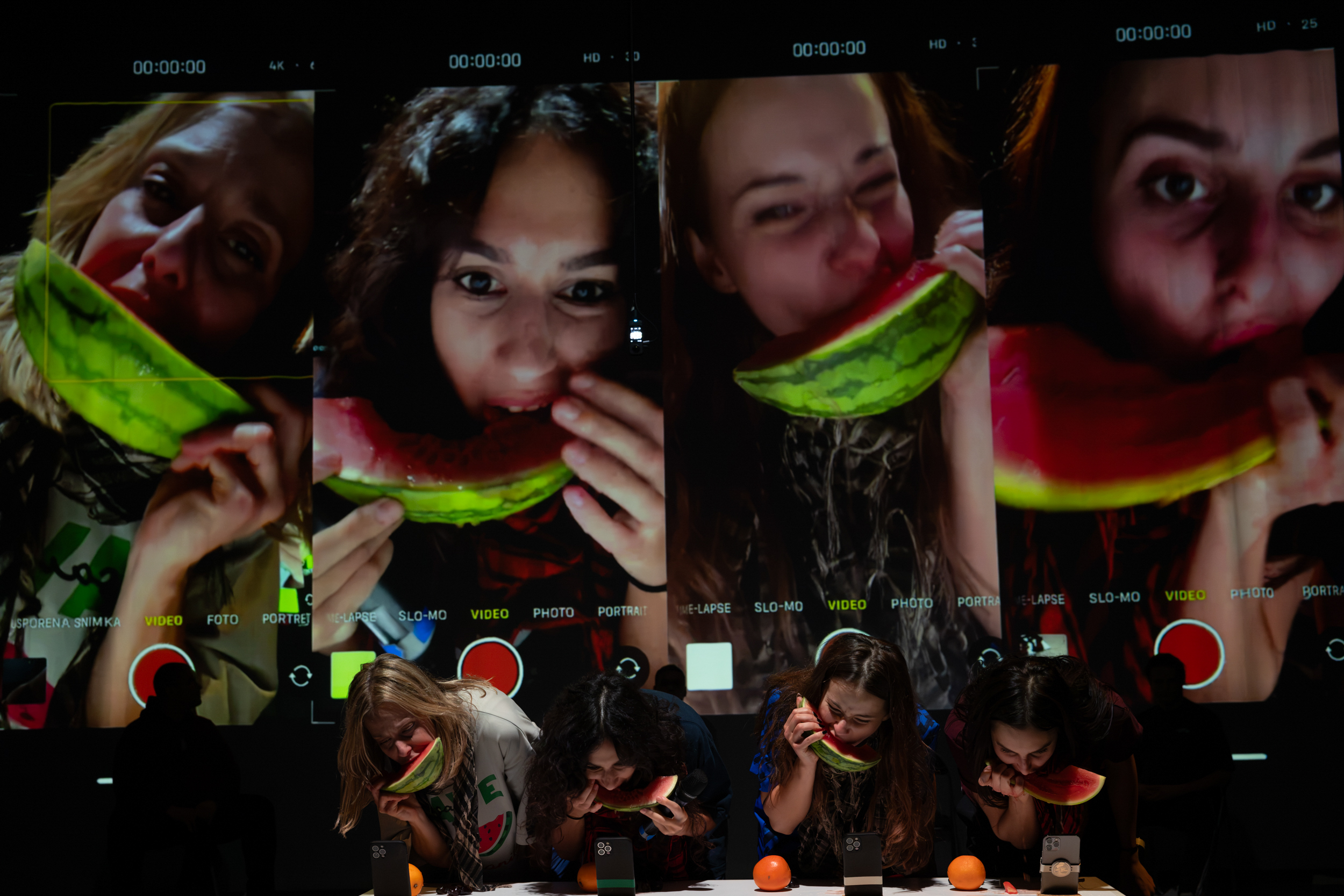
WATERMELON, a project by Borut Šeparović, opens as a pub quiz. The audience is given an answer sheet. There are twenty-one questions over four rounds, and the first is about watermelon, a fruit whose colours have become a symbol of solidarity with Palestine. Scenes from everyday life in Croatia unfold between questions about Palestinian culture and history. Someone wants to eat a date; someone else scans a barcode. In a few lines, an ordinary purchase turns into a debate about where the goods come from and who is actually affected by a boycott.

In an imagined selection for Croatia’s Eurovision entry, words spoken by the Palestinian writer Ghassan Kanafani in an archival interview are set to music. Refaat Alareer’s If I Must Die is performed in English and in a Croatian verse adaptation. The rules of Dora 2027 are read alongside these performances. Could songs based on the work of Palestinian writers represent Croatia in a contest that describes itself as non-political?

Quiz questions, songs and conversations follow the rhythm of a social media feed. On screen, you can go from images of destruction in Gaza to the next post, just as you can change the subject in mid-conversation. The audience sees the action on stage and the image framed by the live camera at the same time. The screen reveals a detail you might miss from your seat. The rest of the scene stays out of frame.

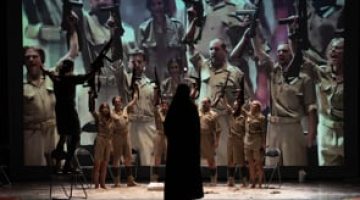
In the second part, the performance stays with a single event. At the Nirim military outpost in 1949, members of the Israeli army detained, raped and killed a Bedouin girl. To reconstruct the crime, the production draws on an investigation by Aviv Lavie and Moshe Gorali, published in Haaretz, and Adania Shibli’s novel Minor Detail. In the excerpt from the article, soldiers drive two men away by firing into the air. In the novel, they kill them. Both versions are staged and their sources identified. The published account does not give the girl’s name.

Voting returns in the second part. The soldiers raise their hands to decide what to do with the girl they have detained. The music cuts out. Orders follow. We also hear the order to investigate the crime and the different verdicts handed down by an Israeli military court. We can follow who makes the decisions, who carries out the order and how most of the soldiers take part in the crime. Afterwards, the choices made in the first part — from the quiz answers to the Eurovision entry — have a different ring.

The starting point is how we look at Palestine from Croatia: what reaches us at all, who decides what we get to see and how long we stay with what we have seen. Between what we choose to buy, the images we can scroll past and the policies pursued in our name, WATERMELON asks where our responsibility begins.
Credits

Writer, director and set designer: Borut Šeparović / Dramaturgy: Filip Rutić, Ivana Vuković / Cast: Petra Cicvarić, Andro Damiš, Dora Dimić Rakar, Jakov Jozić, Nino Pavleković, Nina Spasović, Bernard Tomić, Asja Vidović, Andrija Žunac / Songs, music selection and sound (with generative AI processing): MONTAЖ$TROJ / Musical quotations: Johann Sebastian Bach, Ludwig van Beethoven, Niccolò Paganini, Sergei Prokofiev, Domenico Scarlatti, Franz Schubert, Dmitri Shostakovich, Antonio Vivaldi / Video, multimedia and AI programming: Konrad Mulvaj and AI / Live video and drone operation: Konrad Mulvaj / Multimedia and video assistant: Dario Stojčević / Costume design: Desanka Janković / Lighting design: Anton Modrušan / Stage movement consultant: Roberta Milevoj / Stage movement research collaborators: Martina Tomić, Anna Javoran, Jana Božić / Stage manager: Nikola Belavić / Technical direction: Robert Mazarek / Lighting operators: Robert Pavlić, Leon Šoštarić / Sound operators: Bojan Blažević, Dominik Skolan / Technical support: Mario Jakovljević, Benjamin Paulić / Dresser: Mirjana Špehar / Photography: Jelena Janković / Filming and editing (trailer and recording of the premiere): Lovro Mrđen / Marketing: Željka Božić-Žgela, Zrinka Černoš Čepurkovski, Dubravka Grgec, Edita Prgomet Bošnjak / Public relations: PRiredba studio / Acknowledgements: Oliver Frljić, Kornelija Krpačić, Antonija Kuzmanić, Marija Bingula, Yousef Aljamal, EURO-TON d.o.o. (technical support) / Supported by: City of Karlovac, Ministry of Culture and Media of the Republic of Croatia, City of Zagreb – City Office for Culture and Civil Society, Kultura nova Foundation / Co-production: Zorin dom City Theatre and MONTAЖ$TROJ

SOURCES

Aviv Lavie and Moshe Gorali – “I Saw Fit to Remove Her From the World” (Haaretz, 29 October 2003) / “Continuation of ‘I Saw Fit to Remove Her From the World’” (Haaretz, 29 October 2003) / Adania Shibli – Minor Detail (first published in 2017; Sporedan detalj, Buybook edition) / Oliver Frljić – research materials supplied from the development of Eine Nebensache, a stage project based on Adania Shibli’s novel (video recordings, texts and other preparatory materials, Maxim Gorki Theater, Berlin, 2025) / Jacqueline Reem Salloum – Planet of the Arabs (short experimental film, 2005) / Ghassan Kanafani – interview with Richard Carleton for ABC News (16 October 1970) / Refaat Alareer – If I Must Die(poem, 2011) / Yuval Abraham – “‘Lavender’: The AI machine directing Israel’s bombing spree in Gaza” (+972 Magazine and Local Call, 2024) / Croatian Radiotelevision – Dora 2027 Competition Rules (published in 2026)

Montažstroj
Privacy Overview

This website uses cookies so that we can provide you with the best user experience possible. Cookie information is stored in your browser and performs functions such as recognising you when you return to our website and helping our team to understand which sections of the website you find most interesting and useful.