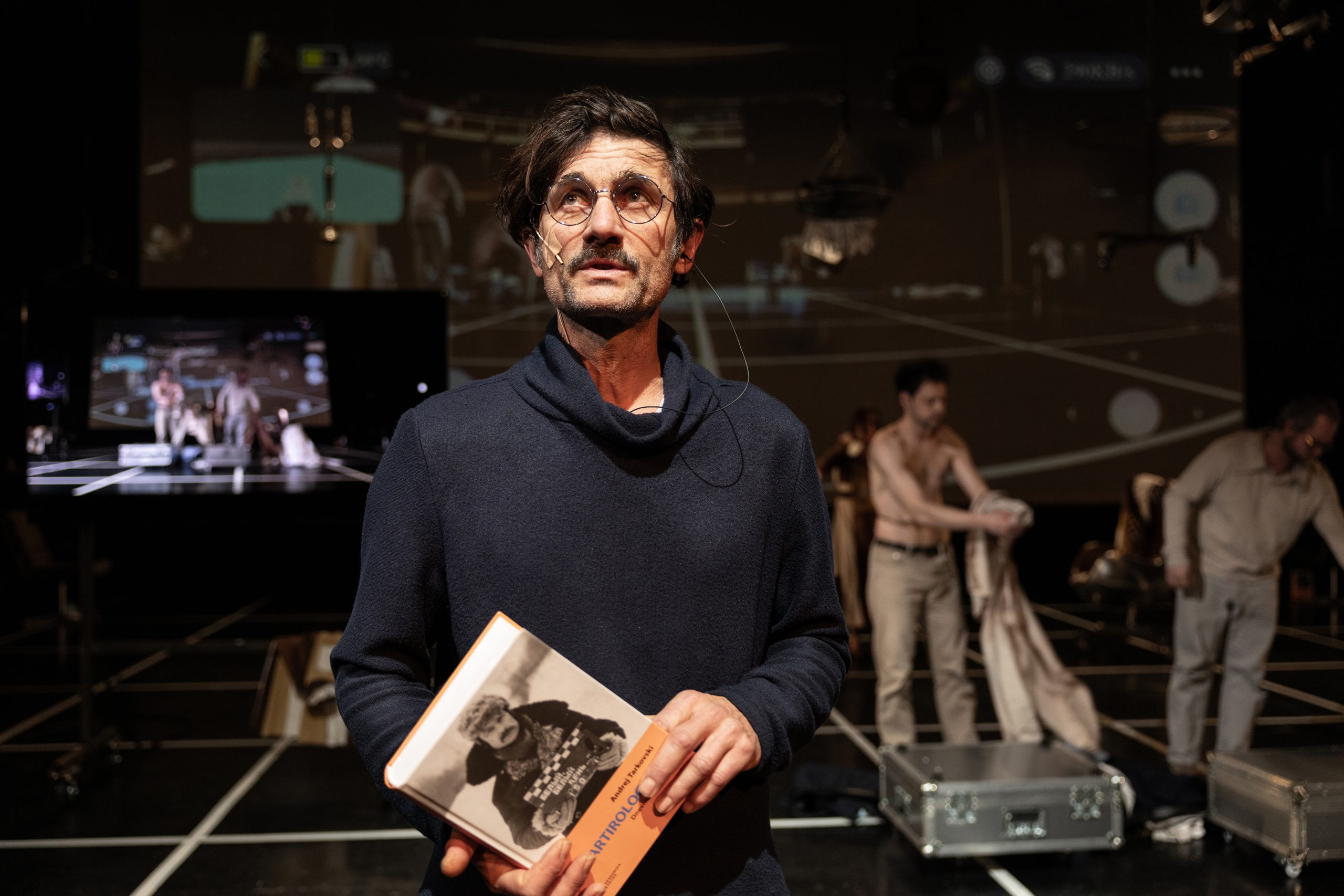
The performance SOLARIS DVA builds on Stanisław Lem’s novel Solaris and Andrei Tarkovsky’s film of the same name from 1972, opening up questions of otherness and self-knowledge through the motif of “guests” — returns that are not an answer, but a mirror. In this reinterpretation, Solaris is no longer a distant planet with a mysterious ocean, but an omnipresent digital infrastructure: an algorithmic “ocean” that mediates our perception, habits, desires and fears. What returns to us is eerily close, convincing — and often wrong.
Šeparović introduces the concept of the “theatrical seam”: unlike the screen, which strives for smoothness and invisible transitions, theatre is a space in which the junction of body, image and technology can never be fully concealed. It is precisely within this seam, at the moment when the copy “betrays” its own perfection, that the performance opens up the crucial questions of our time: who has a right to the original, what does identity mean when it can be reproduced endlessly, and can we forget at all in a world that remembers everything?
SOLARIS DVA is structured as an encounter between the archival level — Tarkovsky’s Solaris from 1972 — live performance and the generative level of AI and deepfake technology: the familiar cinematic image is translated into stage action, then dissolved into a digital cloud of data. The characters are not merely vehicles of the plot, but multilayered constructs suspended between the “recorded” and the “live”. At the centre of this collision is Hari, played by Rea Bušić — a figure of love and loss who appears as a hybrid: in the projections, her face is created by blending the performer’s face with that of the film actress Natalya Bondarchuk, while Kris Kelvin, played by Matija Čigir, enters into dialogue with his own cinematic past. They are joined by Nikola Nedić as Dr. Snaut and Sven Medvešek as Dr. Sartorius, with Frano Mašković as Dr. Gibarian and Vedran Živolić as Henri Berton appearing as video/AI presences. A particular tension is introduced by the robotic dog Unitree Go2 AIR — not as a prop, but as a stage actor testing the limits of empathy: how quickly and easily does the human gaze begin to attribute feelings to a mechanism made of metal and code?
The sound layer of the performance emerges in dialogue with the music from Andrei Tarkovsky’s film — Eduard Artemyev / J. S. Bach — with original interventions by Montažstroj and AI processing, creating an atmosphere that is at once nostalgic and unsettlingly new, as though memory itself sounds “recognisable”, yet is no longer the same.
The dramaturgy is by Filip Rutić; the visual and technological identity is shaped by Konrad Mulvaj; the set design is by Filip Triplat; costumes are by Desanka Janković; lighting design is by Anton Modrušan; and stage movement is by Roberta Milevoj.
The ZKM guest performance continues the collaboration between ZKM and INK, as well as Montažstroj’s ongoing presence in this theatre: Zagreb audiences will have the opportunity to experience this “digital ocean” up close — in a space where truth and falsehood are not measured by resolution, but always return to the body, breath and time of performance.