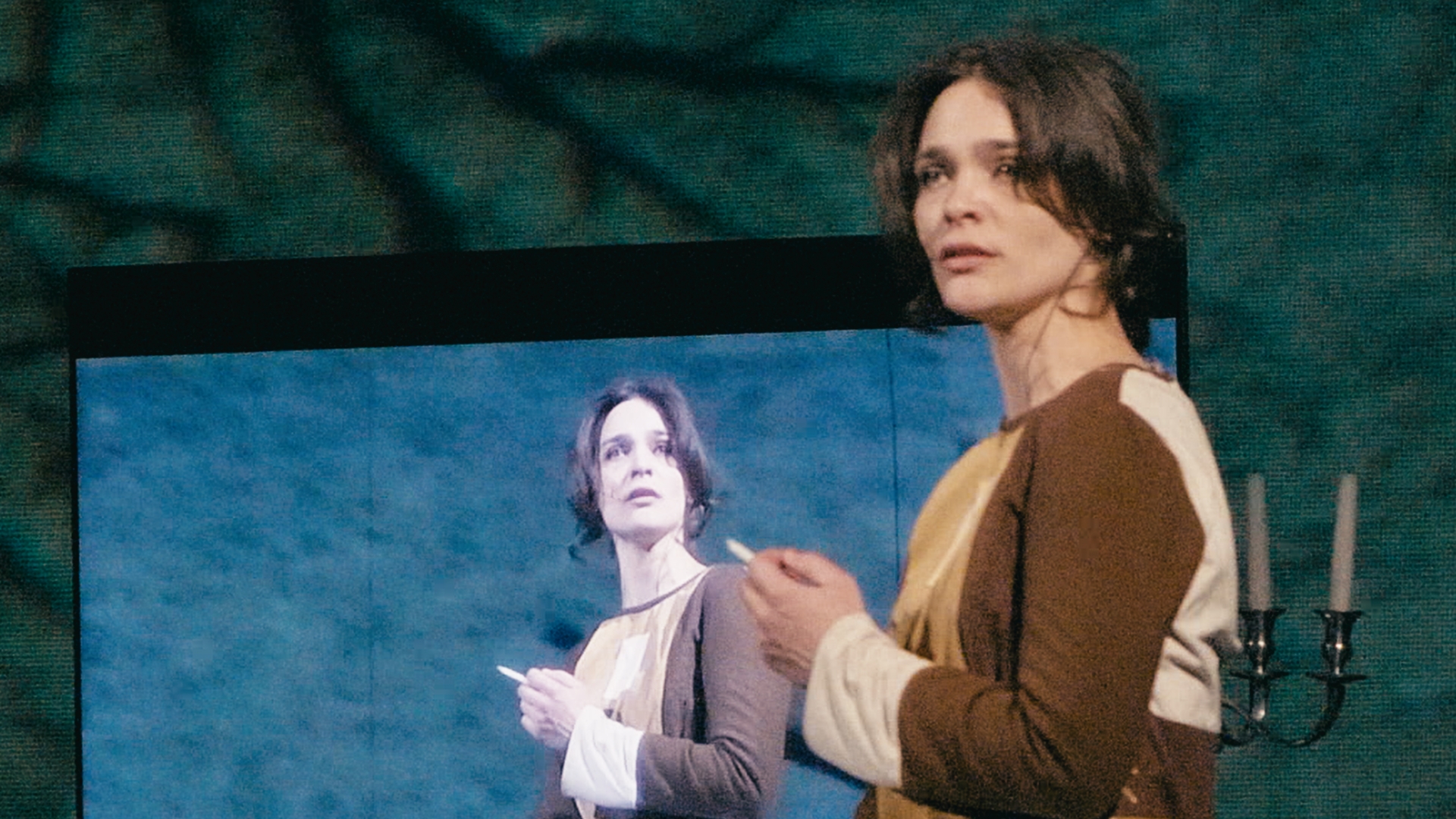
Borut Šeparović’s original project, created in co-production between the artistic collective MONTAŽSTROJ and the Istrian National Theatre – City Theatre of Pula, will be performed again on 9 and 10 June at 8 p.m. in the Istra Hall of Zagreb Youth Theatre.
The return of the performance to Zagreb is accompanied by the premiere of the music video ZELENA TRAVA, a new artistic extension of the SOLARIS TWO project. The video is not conceived as a conventional promotional trailer for the performances, but as an independent visual and sound work that expands the world of the production beyond the theatre stage.
At the centre of the music video is a hybrid voice that merges the live voice of actress Rea Bušić with a voice generated by artificial intelligence. The result is a vocal presence that is at once intimate and displaced, human and processed, recognisable and unstable. In this way, the video continues one of the central questions of the performance: where does human presence end, and where does its technologically produced version begin?
The musical foundation was created with the help of artificial intelligence and draws on a fusion of minimal/ambient techno, microhouse and analogue bass. The electronic rhythm accompanies lyrics about loneliness, distance and a longing for home: astronauts in space do not dream of technological grandeur, but of the simplest earthly image — green grass in front of a house. In this meeting of digital sound and human nostalgia, the question emerges of whether technology can produce an emotion we are willing to believe in.
Visually, ZELENA TRAVA continues the aesthetic of the performance and condenses its performative world: live stage action, archival materials from Andrej Tarkovski’s film Solaris, deepfake projections, lighting and pyrotechnic effects, and the robotic dog Unitree Go2 AIR. In the performance, the robot does not function as a prop, but as a non-human performer testing the boundaries of empathy toward machine, sensor and code.
The performance SOLARIS TWO takes Stanisław Lem’s novel Solaris and Andrej Tarkovski’s 1972 film as its starting points, but Šeparović does not approach them as an adaptation. Instead, he places them in the contemporary context of generative artificial intelligence, deepfake and digital archives — at a time when the boundaries between the living body, the film image and computer-generated reality are becoming increasingly unstable.
At the centre of the performance is the character of Hari, played by Rea Bušić — a figure of love, loss and return, at once physically present and digitally reconstructed through AI and deepfake processes, including a fusion with the face of Natalija Bondarčuk from Tarkovski’s film.
SOLARIS TWO does not use technology as decoration, but as an equal performative material. AI, deepfake, archival film, the live actor’s body, projection, robotics and the hybrid voice function as layers of performance through which questions of perception, trust, memory and authenticity are opened up.
The June performances are therefore not merely repeat performances, but a continuation of the project’s life after its Pula premiere, its Zagreb performances, and the responses of audiences and critics, while the new music video ZELENA TRAVA further expands its media and artistic space beyond the stage.