SOLARIS TWO continues Montažstroj’s long-standing practice of working with archives, reconstruction, and “materials of the past” that, in the present, are transformed into performative evidence. This time, the archive is film — not as a finished artefact, but as an active interlocutor: a previous life returning into the body and time of theatre.
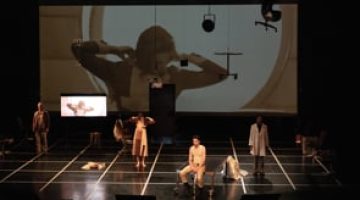
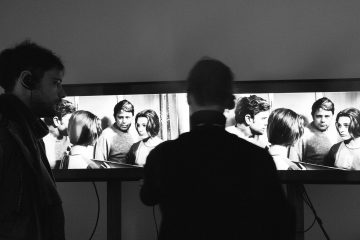
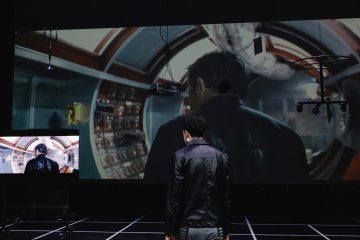
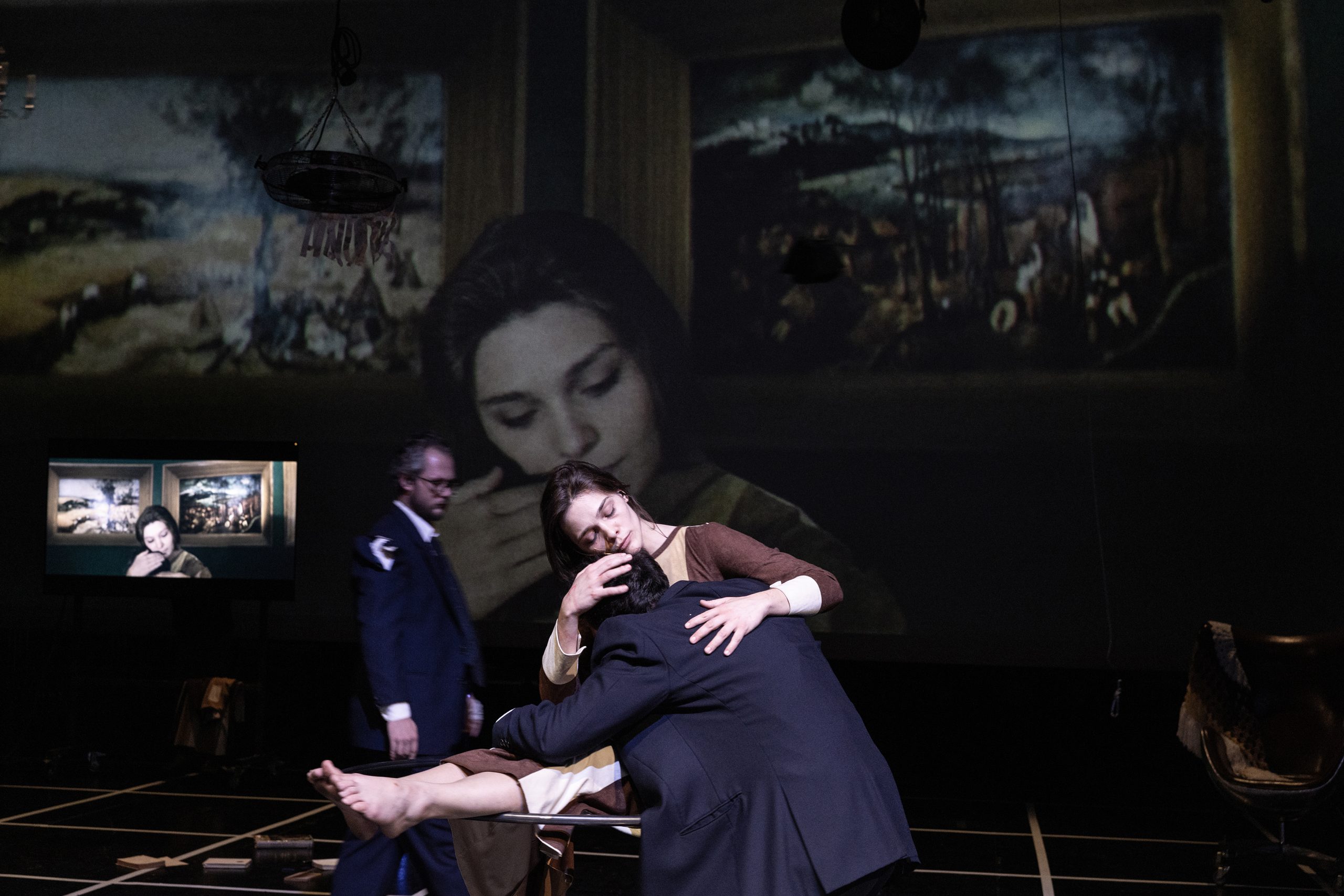
Here, film is a score. In real time, the performance establishes three presences: Andrei Tarkovsky’s original film, its precise stage reconstruction, and a computer-generated fusion that emerges between these two layers. The film is neither “in the background” nor used as a quotation — it remains a constant point of reference. The actors, within the same time code, reproduce the rhythm, movement, and intonation of the film characters, while deepfake technology, at certain moments, lets the identity of the live performer flow into the filmic body.
Technology here is not an addition, but dramaturgy: the double comes into being before the audience, and watching itself becomes the action — a continual testing of what is live, what is recorded, and what is synthesized.
At the centre is psychologist Kris Kelvin (Matija Čigir). He is confronted with “guests” — apparitions created from fragments of memory and the unconscious. Hari (Rea Bušić), the double of his deceased partner, is at once tangibly present and radically unreal: the body is on stage, while deepfake technology occasionally “borrows” a face from the film archive. At one moment, three Haris meet — the filmic, the theatrical, and the computer-generated — and it is precisely in that thin fissure between media that SOLARIS TWO takes place.
Alongside Kelvin and Hari, Snaut (Nikola Nedić) and Sartorius (Sven Medvešek) also appear on stage, while the performance expands into video/AI-hybrid appearances: Dr. Gibarian (Frano Mašković) and pilot Henri Berton (Vedran Živolić) exist exclusively as recorded presences. As an additional “guest,” the robotic dog Unitree Go2 AIR also appears — a non-human performer that brings into the Solaris logic of otherness a body sharing the same space and the same time with humans.
The motif of the “guests” comes from Stanisław Lem’s science-fiction novel and Andrei Tarkovsky’s film. The Ocean creates materializations of memory, guilt, and desire — as a response to the impossibility of contact with the unknown. SOLARIS TWO translates this principle into the language of today’s “infinite cloud of data”: the Ocean is read as an algorithm, a generative system that reconstructs identities from archives and digital traces.
Just as the Ocean reconstructs Hari from Kelvin’s memory, contemporary models produce convincing copies from data — the mirror of Solaris today is the computer.
Deepfake changes the fundamental position of the actor. A role is not built “from nothing”; instead, an already existing form — a film performance — is inhabited and becomes its living double. Film becomes a metronome, and the performer an instrument of precise alignment: entrance, tempo, pause, gaze, micro-movement. And yet the performer remains irreversibly alive. That is why authorship ceases to be stable: who is “performing” — the body on stage, the film archive, or the algorithm producing a new image?
The error is not hidden — it is an argument. The performance deliberately uses glitch: the digital mask cracks, falls apart, “slips away,” and reveals its own artificiality. A glitch occurs when the algorithm loses its “landmarks” — facial points it uses as geometric anchors — so the mask stretches incorrectly, and the system, instead of understanding the structure of the face, begins to guess statistically. Where the algorithm cracks, the performer’s biological noise appears: the living labour of body, breath, and time.
The fissure between matrix and performance ceases to be a problem that needs to be “fixed” and becomes a space in which theatre becomes real again — because it is happening now.
In the historical background of the film there is also the institutional control of the image. Ideological “approvals,” censorship, and demands that the message be clearer, more optimistic, and more “correct” are not a footnote here, but a case study in the management of meaning. SOLARIS TWO brings together two eras of surveillance: the institutional one, and today’s data-driven, algorithmic one, in which the image is selected, filtered, and generated.
In this way, the project directly opens an ethical question that reaches beyond the boundaries of theatre. If we can convincingly produce someone’s face and voice, who has the right to that presence, and under what conditions? SOLARIS TWO does not treat AI as a neutral tool, but as an ambivalent force that demands a political and ethical framework — consent, ownership of the face and voice, authorial responsibility, and, crucially, the question of trust in the image.